Language is one of the most exciting and meaningful developmental milestones in early childhood. From the first sweet coos to those unforgettable first words, the journey toward speech is packed with tiny breakthroughs that reveal how babies begin to understand, process and eventually express their thoughts.
In this guide, we walk you through a month-by-month breakdown of speech development, outline when infants typically start to talk, and offer actionable tips to support your child’s communication journey from infancy through toddlerhood.
Along the way, we’ll also share how early learning programs like The Learning Nest help nurture strong early language skills through responsive caregiving, literacy-rich environments.
Why Early Language Matters
Language is more than words. It’s how children learn to connect, express needs, explore ideas and make sense of their world. Research shows that children with strong language skills are more likely to succeed academically, develop strong social-emotional regulation and enjoy lifelong confidence in learning environments.
At The Learning Nest, language development is embedded into every aspect of our programs, from baby sign language and daily storytelling to meaningful conversations during meals and playtimes. We meet children where they are developmentally and offer language-rich experiences tailored to each stage.
Baby Talk: Month-by-Month Language Milestones
0–3 Months: Sensory Awareness & Early Sounds
- What to Expect: Your baby is already communicating from birth, through cries, eye contact and different vocal tones.
- Milestones:
- Reacts to your voice and familiar sounds
- Begins cooing (soft vowel sounds like “ahhh” and “ohh”)
- Shows preference for parent’s voice and facial expressions
- How to Support:
- Talk, sing and narrate your activities (“Now we’re changing your diaper!”)
- Maintain eye contact and smile back, this helps build trust and attention
4–6 Months: Cooing Turns into Babbling
- Milestones:
- Babbling begins (“ba,” “da,” “ga”)
- Laughs and squeals in response to interaction
- Starts to mimic tone and pitch of adult speech
- How to Support:
- Repeat sounds your baby makes
- Use a cheerful, animated tone, “parentese” helps babies pick up on speech patterns
7–9 Months: Understanding Begins
- Milestones:
- Recognizes their name and common words (“bye-bye,” “milk”)
- Babbling becomes more complex (“babababa”)
- Begins using gestures like waving or pointing
- How to Support:
- Label everything around you (“Here’s your bottle!”)
- Read daily with short board books and describe the pictures
10–12 Months: First Words Emerge
- Milestones:
- May say “mama,” “dada” or other meaningful words
- Understands simple commands like “come here” or “no”
- Points or makes sounds to indicate wants
- How to Support:
- Continue narrating your day and use baby sign language for basic needs
- Encourage turn-taking in conversation by pausing after you speak
12–18 Months: Vocabulary Growth Begins
- Milestones:
- Uses 5–10 words clearly
- Understands simple questions and follows instructions
- Imitates words and begins combining gestures with speech
- How to Support:
- Offer choices with words (“Do you want water or milk?”)
- Describe emotions, actions and routines to build comprehension
18–24 Months: Combining Words
- Milestones:
- Vocabulary grows to 50+ words
- Begins forming two-word combinations (“more juice,” “mommy help”)
- Can point to body parts and name familiar objects
- How to Support:
- Expand on your child’s words: If they say “dog,” respond with “Yes, the dog is big!”
- Continue reading daily, especially interactive or rhyming books
24–36 Months: Expressive Communication Blooms
- Milestones:
- Uses simple sentences
- Understands and answers simple questions
- Engages in back-and-forth conversation and imaginative play
- How to Support:
- Ask open-ended questions (“What did you build today?”)
- Model clear pronunciation and grammar without correcting harshly
How The Learning Nest Nurtures Early Language
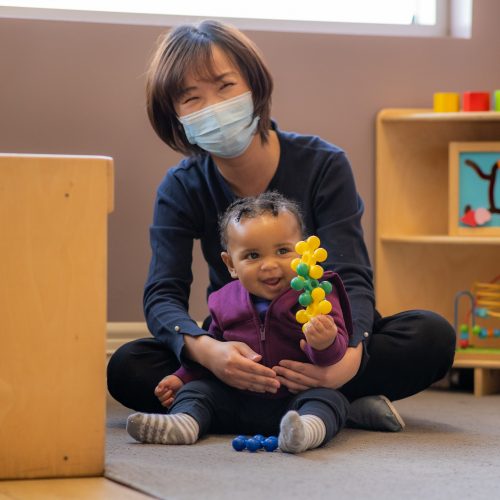
Teacher sitting on floor with baby in her lap
At The Learning Nest, our programs are designed to foster language development from the very beginning:
Infant Program
- We introduce Baby Signs as early as three months, helping babies express needs before they can talk.
- Daily one-on-one interactions during feeding, diapering and learning activities provide responsive language modeling.
- Educators narrate every action, describe emotions and use facial expressions to build receptive language.
Toddler Program
- Language-rich environments filled with music, stories and conversations help toddlers expand vocabulary.
- Educators use repetition, naming and open-ended questions to support expressive language.
- Activities like sensory play and dramatic play are integrated with vocabulary-building prompts.
Preschool Program
- Emergent literacy is supported through phonological awareness, letter recognition, storytelling and our Jolly Phonics program.
- Children practice conversations, storytelling and question-asking in a nurturing group setting.
- Our learning model encourages peer-to-peer communication and cooperative learning.
Explore each age-specific program:
FAQs: Talking Milestones and When to Seek Help
What if my child isn’t talking yet?
Every child develops at their own pace. Delayed speech alone doesn’t always indicate a problem. Overall communication, gestures, eye contact and comprehension are important too.
When should I talk to my doctor?
If by 18 months your child:
- Isn’t saying at least 6–10 words
- Doesn’t respond to name
- Shows limited gestures or eye contact
Or if by 24 months:
- Isn’t combining two words
- Has trouble understanding simple commands
- Seems frustrated by communication difficulties
It’s a good idea to consult your pediatrician or a speech-language pathologist. Early intervention can make a big difference.
Building a Foundation for Lifelong Communication
The journey from babbling to full conversation is one of the most incredible transformations in a child’s early life. As parents and caregivers, your support from narrating daily routines to sharing stories and songs, builds the foundation for language and literacy.
At The Learning Nest, we understand the power of early communication. Our educators are trained to nurture language in warm, engaging and developmentally appropriate ways, giving your child the tools to connect, express and grow with confidence.
Ready to support your child’s communication journey? Explore our programs or book a tour today!